
She was born in Farrukhabad and went to the US to pursue her master's degree and a Ph.D.

Infosys was the top gainer in the Sensex pack, rising over 2 per cent, followed by Bajaj Finance, HCL Tech, Tata Steel, Tech Mahindra and NTPC. On the other hand, Maruti, Sun Pharma, HUL and ITC were among the laggards. Nifty rose 122.15 points to 17,343.55.

Tech Mahindra, the top loser in the Sensex pack, shed over 2.5 per cent. It was followed by UltraTech Cement, Reliance Industries, HCL Tech, HDFC, Kotak Bank, HDFC Bank and TCS. NSE Nifty plunged 179.35 points to 17,745.90.

The Lok Sabha elections in 2024 are not a consideration when it comes to monetary policymaking, said Reserve Bank of India governor Shaktikanta Das to underscore the central bank's commitment to controlling inflation. "It's not possible for me to comment what we do in the next MPC (Monetary Policy Committee), but one thing I can tell and I would like to make it very clear-that the fact of elections coming up in 2024 is not a factor at all so far as monetary policymaking is concerned. "Monetary policymaking is for checking (and) controlling inflation," Das said at the Business Standard, BFSI Insight Summit.

Gold prices hit record high in the third week of March as fears of bank collapses and high inflation led investors to the traditional safe haven. Gold prices are often inversely correlated to dollar strength because the international price is dollar-denominated. The Federal Reserve's (Fed's) stance indicates that the dollar may appreciate further since it is prepared to keep pushing up policy rates. But demand for gold is also up - the World Gold Council claims central banks are buying in addition to private demand.

Without naming India, S&P said it expects that in regions where inflation already exceeds targets, or which are vulnerable to capital flight, central banks will be forced to raise interest rates.

'For someone who wants to invest for the future or his family, diversification is necessary.' 'Diversify across asset classes -- equities, gold, real estate, fixed income, commodities, and even cryptocurrency.'

'New record for the Nifty50 is only a question of when.'

The 30-share Sensex ended flat at 21,833 and 50-share Nifty gained 7 points at 6,524.

The 30-share Sensex ended down 66 points at 28,438 and the Nifty ended down 15 points at 8,633.

Foreign portfolio investors (FPIs) infused Rs 11,630 crore in the Indian equity markets in April on the reasonable valuation of stocks and appreciation in the rupee. This came after FPIs infused a net sum of Rs 7,936 crore in equities in March, mainly driven by bulk investment in the Adani Group companies by the US-based GQG Partners. However, if one adjusts for the investments of GQG in Adani Group, the net flow was negative.

'The Indian economy and the Indian financial sector today remain resilient and much better placed.'
The US Federal Reserve has announced to maintain its bond purchase tapering programme.

The S&P BSE Sensex gained 57 points to end at 26,064 and the Nifty50 climbed 17 points.
The rupee appreciated 7 paise to 79.74 against the US dollar in early trade on Thursday as a positive trend in domestic equities supported the local unit. However, a strong American currency overseas and forex outflows restricted the rupee's gain, dealers said. At the interbank foreign exchange, the rupee opened at 79.72 against the American dollar, then went lower to trade at 79.74 against the greenback in early deals, registering a gain of 7 paise over the last close.

HCL Tech was the top loser in the Sensex pack, skidding over 4 per cent, followed by Tech Mahindra Dr Reddy's, Wipro, TCS, Titan and Infosys. NSE Nifty plunged 167.80 points to 17,110.15.

The US Fed interest rate decision, domestic macroeconomic data announcements and ongoing quarterly earnings are some of the major factors that will drive the stock markets in a holiday-shortened week, analysts said. Besides, monthly auto sales numbers and the LIC IPO will also remain in focus, they added. Equity markets will remain closed on Tuesday for Id-Ul-Fitr (Ramzan Id). "The market is likely to kick off this week on a sombre note after a sharp fall in the US market then the focus will shift to the outcome of the US FOMC meeting, which is crucial amid record inflation and growth worries.

ITC, Sun Pharma, Maruti, M&M, Tata Motors, HCL Tech, Wipro, Infosys, HUL, Bharti Airtel and Reliance were among the major losers. Kotak Bank rose the most by 1.59 per cent, followed by IndusInd Bank, Bajaj Finance and Bajaj Finserv. L&T, SBI, TCS and HDFC Bank also closed higher.

In the backdrop of the US economy slowly improving, the US Federal Reserve chairman Ben S Bernanke has said that stricter regulatory measures would be the 'best' response to tackle housing bubble.

'We have a plan to plough back a 'This year in the first half we had profits of more than Rs 31,000 crore.' significant amount of profits this financial year.' 'We have seen this organic plough back of profit is one of best ways to support the equity of the bank.'

With the international markets facing uncertainty after Russia invaded Ukraine and Western nations retaliated with sanctions, Indian companies are putting their international fundraising plans on hold as they wait for the markets to recover. Bankers said apart from the geopolitical crisis, international rates are hardening in anticipation of interest rate hikes by the US Federal Reserve to control rising prices in the US. The Ukraine situation has implications for the market. In such a situation, international investors try to shift to safe haven assets by exiting from emerging markets.

Foreign portfolio investors (FPIs) turned net buyers in October after being net sellers in the previous month. In October, FPIs bought shares worth nearly Rs 8,430 crore ($1 billion) against net selling of Rs 13,405 crore ($1.6 billion) in September. Positive flows during three of the previous four months have pushed the domestic markets towards fresh all-time highs. At present, the Sensex and Nifty are less than 2 per cent shy of breaching record highs logged in October 2021. A rally in equity markets in the US and Europe is in hopes that the Federal Reserve may go soft on rate hikes after its November meeting.

Global rating agency S&P on Tuesday said even though the US and the Euro zone are headed to recession, India is unlikely to face the impact given the "not so coupled" nature of its economy with the global economy. "Indian economy is a lot decoupled from the global economy than we normally think of, given its large domestic demand, even though you (India) are a net importer of energy. "But you have enough forex reserves on one hand and your companies have managed to maintain healthy balance sheets," Paul F Gruenwald, S&P global chief economist and managing director, told reporters in Mumbai.

Rupee and bonds weakened on Thursday after the US Federal Reserve signalled it may increase its policy rates at the next meeting in December.

'Hope they don't tinker around with capital gains tax in any way.'

The rupee on Wednesday declined by 16 paise to close at its fresh lifetime low of 77.60 against the US dollar amid unabated foreign fund outflows and a stronger greenback in overseas markets. At the interbank foreign exchange market, the rupee opened lower at 77.57 and later hit the day's low of 77.61 as the dollar rebounded in global markets following hawkish comments from US Federal Reserve chief Jerome Powell. Crude oil prices also surged over 1 per cent, which weighed on the rupee.

'The government is trying to kickstart the investment cycle in India and while the corporate investments are yet to gather momentum, there are early signs of the same.'

'Earning expectations remain strong.'

Few actors share Kareena's fearlessness for closeups in their 40s. A still force in a high-strung thriller, her marvellously opaque portrayal of a woman hiding skeletons in her closet turns a crafty police procedural into a wistful story of survival, observes Sukanya Verma.

A yellow glow is likely to stand out amid grey geopolitical clouds in 2023, with gold price projected to touch Rs 60,000 per 10 grams in the Indian market as more investors veer towards safe-haven assets. In a year where volatility was more a norm than an exception, gold prices in the international market oscillated from a peak of $2,070 per ounce in March to a low of $1,616 per ounce in November and is steadily recovering since then, according to market experts. At the beginning of 2022, gold prices were around $1,800 an ounce.

'If Manipur is divided on ethnic lines, similar demands will come in other states also.'

The winter session of Parliament will commence on November 26.

Following are the highlights of the Economic Survey 2022-23 tabled in Parliament on Tuesday
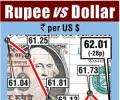
The RBI is widely expected to raise its key repo rate by 25 basis points to 8.00 per cent on Wednesday, its third such hike in four months after recent data showed both wholesale and retail inflation at multi-month highs.

There has been a stellar rise for the Indian markets this far in calendar year 2021 (CY21) with the S&P BSE Sensex surging over 19 per cent. The gain in mid-and small-cap indices on the BSE has been sharper with both these indexes surging around 38 per cent and 54 per cent, respectively during this period. Rampant spread of Covid pandemic's Delta variant and the ensuing lockdown and mobility curbs across India, rising prices key commodities, including crude oil and its impact on inflation, possibility of tightening of policy stance by major global central banks, especially the US Federal Reserve (US Fed) have been some of the key headwinds that the markets successfully negotiated during this period.

Analysts caution against volatility and recommend buying stocks of companies that are on strong fundamental footing that have been beaten down badly in the recent carnage.

The market breadth was firm. Out of 2,933 stocks traded , 1,685 stocks advanced compared to 1,136 declined on BSE.

The re-opening of the Chinese economy, as it moves away from its zero-Covid policy, could help stabilise commodity prices, according to some of the country's top metal companies. They view this as a positive for demand, at a time when markets such as the US and Europe have been largely weighed down by slowdown concern now. "Most of us in the metals business are hoping the Chinese economy picks up because half of any metal demand, including demand for aluminium, comes from China.

FPIs have turned net sellers in 2022 after being net buyers in the last three years.
